
Playing the "butter notes"
On owning your craft.

People who become 'elite' at what they do aren't striving to be 'elite' just to join some special club. They take great joy and satisfaction in the pursuit of mastery, and they compete against themselves, not others.
Justine Musk
If you ask a jazz enthusiast (it doesn’t even need to be a fan) about the “butter notes”, you’ll probably be presented with one of the most recognized stories in the jazz scene.
It has been told multiple times by both teachers and musicians as a way to illustrate a point, featuring 2 legends: Herbie Hancock and Miles Davis.
In May 1963, Herbie started to play piano for the Miles David Quintet. The opportunity to play with the most famous jazz musician of all time was not something Herbie was expecting, but he took advantage of it, learning and developing his own style. It influenced his music and career, but also his thinking and approach to life and business.
In those early days, Herbie felt that his own playing had hit a plateau, making him frustrated about his solos, depressed even.
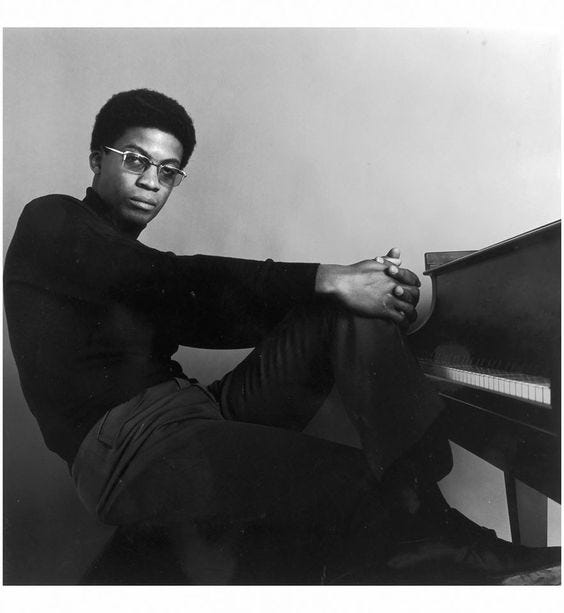
Miles noticed Herbie’s gloomy aura and one day simply told him: “don’t play the butter notes”.
What does that mean, “don’t play the butter notes”?!
One of the seemingly obligatory traits for a master is to speak through metaphors and parables that don’t make sense when met at face value.
Herbie knew that.
I had no idea what he meant, but I knew that if he’d bothered to say it, it was important. So I started to mull it over. What is butter? Butter is fat. Fat is excess. Was I playing to excess? Butter also could refer to something easy, or obvious. Like butter. Was there something obvious about how I’d been playing? If so, how could I change it?
I won’t bore you with (much) musical theory, but here’s some context.
Usually, in music, you have 7-note scales that allow you to build different chords on a given tonality.
In any chord structure, you usually have 4 very important notes: the tonic (which names the chord), the 3rd, 5th and 7th. The 3rd and 7th specifically are very important, defining the sound of the chord.
They make a chord sound clear, easy.
They make a chord sound buttery.
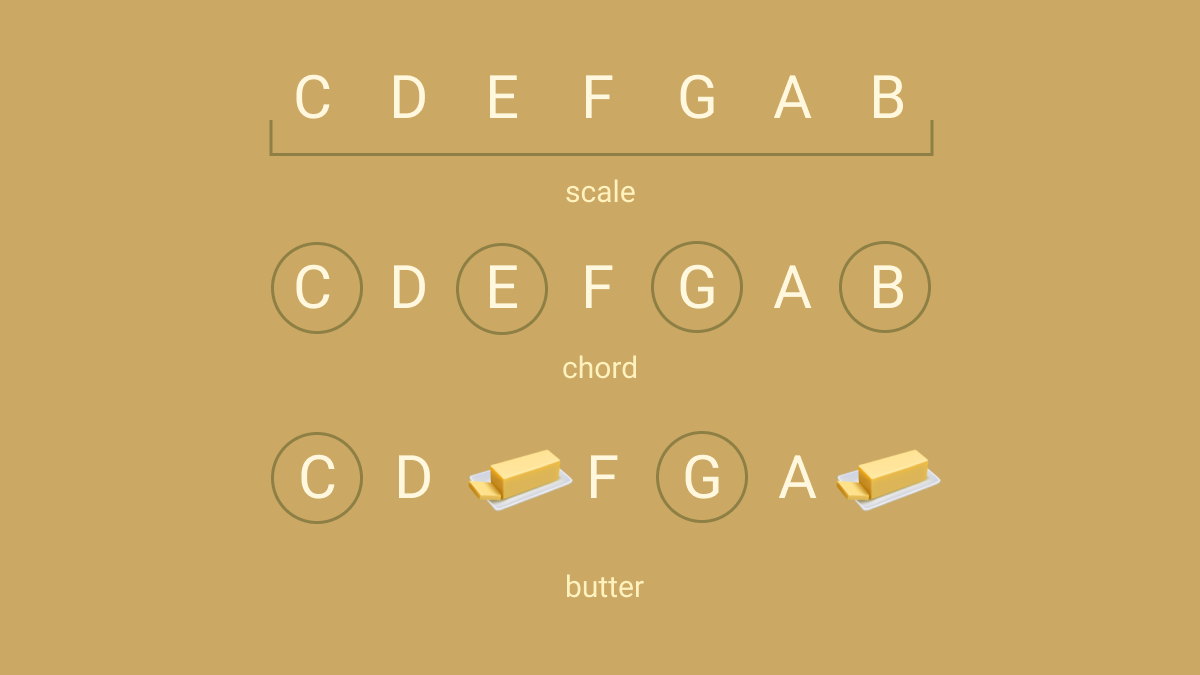
With that piece of advice, Herbie started to be more creative, exploring new harmonies and melodies, avoiding the “butter notes”.
5 words were all it took for a whole new world to open up to Herbie.
The funny thing is that those weren’t even the actual words that Miles used! He said “don’t play the bottom notes” and Herbie misheard it. Turns out that not every master speaks through riddles.
Regardless of that, it carries a message, transversal to different crafts, not just music.
Explore things that are not obvious and cut the “butter” in your own craft.
However, there’s more to it.
Even though most people finish the story there, that’s not the end. In his book, Possibilities, Herbie expands on this story, making a far more interesting point.
He says (emphasis mine):
Once I got accustomed to playing without butter notes, I could start playing them again. Because now they were no longer butter notes: I wasn’t playing them because I had to, like before. I was playing them because I wanted to. And that changed everything for me. All because Miles spoke those five little words.
You’re probably familiar with Joseph Campbell’s framework for myths and narratives: The Hero’s Journey. Thousands of stories, in all their different forms, are a result of this framework, from The Epic of Gilgamesh to Harry Potter.
I won’t go into much detail about it (here's a great video though), but I do want to highlight something: The Hero’s Journey is cyclical.
The hero goes back to the beginning. Everything around it is the same as it was, but inside, something’s different.
That’s the process of change, the structure for growth.
You have a starting point, go through some experience that changes you, usually with some pain associated with it, and then you come back, to the same starting point, but a different individual.
Just like Herbie and butter notes.
I’m obsessed with the concept of Mastery because I believe it’s a fundamental piece in the puzzle of bringing a Modern Golden Age. Solving real problems that you care deeply about, requires that you master your own craft.
So here’s my takeaway from the full Herbie Hancock story, something I intend to remember and it may be of use to you.
Sometimes, the only difference between a master and an apprentice is not the craft or a specific behavior, but the intention behind it.
We just need to learn how to do it.