
The Inconvenient Origin
How Christianity Invented Liberalism, and Why Both Sides Don't Want to Hear It

I once had a friend point out that, if someone can guess your political opinions on every single issue after hearing you speak for a couple of minutes, you’re not thinking critically but subscribing to an ideology. This particular conversation, and the fact that my girlfriend has extremely high levels of critical thinking (besides a great bullshit detector), have shaped a big part of my approach to ideas.
Being challenged on sloppy thinking and writing is a great way to sharpen your worldview. If you research multiple sources and read multiple points of view on a given subject, you get a glimpse of the true complexity of seemingly simple ideas. Only when acknowledging that can you actually start thinking somewhat independently. This is why I’ve come to appreciate ideas that “don’t fit in” when it comes to a political or cultural box. If an idea can “piss off” both sides of whatever issue, it’s either because it’s stupid or truly independent. I enjoy collecting such hypotheses or frameworks.
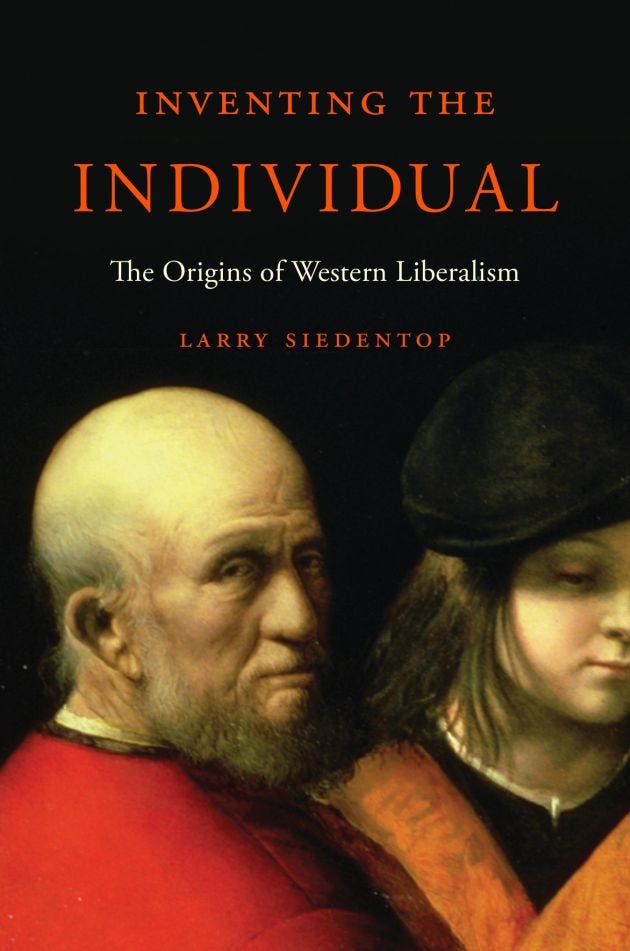
Recently, I stumbled upon Larry Siedentop, an American political philosopher with a great passion for Europe. In 2015, he released “Inventing the Individual”, a book about the history of Liberalism. He claims that in the modern world, we’ve developed a tendency to ignore the role played by Christianity in Liberalism. So much so that he questions whether Liberalism is not merely the logical next step after Christianity.
Let me take a moment to explain why I think this might be one of the so-called “piss-every-side-of-the-issue” ideas.
Far-right parties seem to think that Liberalism and Liberals are the embodiment of degeneracy. Far-left parties seem to think that Religion is merely a structure that justifies harmful traditions in a modern world. Christianity as the source of Liberalism can piss off both sides, which means it’s worth diving into.
To grasp Siedentop’s idea, we must first look at the historical context in which Christianity emerges, specifically the role of religion in Ancient Rome.
In what is considered by many a source of inspiration for the Renaissance years later, citizens inhabited what was called Paterfamilias. The father, head of the family, held absolute authority over its members and property. He served both as the ruler and priest of the household cult, a political and religious figure, a symbol for the lack of freedom of everyone else in the family. There was absolutely no sense of individuality since social roles were attributed at birth.
When the cultural world started to shift and city-states arose, multiple families came together, and the need for a new cult, harmonizing different families within the same space, came into being. Different pagan gods or Roman heroes were some of the choices. A lot of the time, you would have a cult for the founder of the city.
This relevant context contradicts the idea that “secularism” was found in the ancient world. Sure, we didn’t have anything remotely close to an institutionalized religion like the Catholic Church, but tribes, families, and cities, Siedentop argues, were functionally similar to churches.
Liberalism emerged from humanism and the rise of secular reasoning, both intellectual consequences of the Renaissance. The Renaissance drew inspiration from Ancient Rome. That’s the usual idea in people’s minds.
But how ironic is it that the “renaissance man” looked back to a time and place where inequality and rigid social rules were the norm? Virtues were associated with aristocrats, and everyone had their fixed role in society. Siedentop argues that if we want to draw inspiration from Ancient Rome and Greece to somehow shape our worldview, it’s maybe better to do so in cultural dimensions, not political ones.
This is the first part of his critique of the general notion of where Liberalism comes from. These ancient intellectual paths encouraged something much different than what we usually associate with it.
When Christianity came along, it changed everything. It was the first time that we had a “philosophy” with universal application, applied at the individual level. This particular combination was a fundamental piece for our modern world.
So God created mankind in his own image,
in the image of God he created them;
Every (universal) person (individual) is made in accordance with God’s image. Everyone is a unique individual and yet is made Imago Dei. This brought some new moral obligations; after all, if every person is seen as a “Child of God”, social rules and strict hierarchies must be questioned.
Let’s take a moment to appreciate this idea fully:
The far-right religious parties often treat Christianity as a tool for enforcing hierarchy. The far-left parties proudly distance themselves from any form of organized religion. The idea that Liberalism, this “monster” that right-wingers want to slay, grows from Christianity, the institution the left loves to reject, is problematic to both sides. That’s why it’s worth taking seriously.
A great example provided by Siedentop is the social roles of women after the rise of Christianity and how it showcases the social mobility unlocked by this new worldview. Spiritually, husbands now had to see their wives as equals, while also starting to be held accountable for adultery. Christianity gave the first step towards the idea that each person matters at all levels.
Of course, it’s undeniable that the Church as an institution was actually the greatest beneficiary from the shift away from Paterfamilias, growing to a point of corrupting the morals it once held as its cornerstone. And yet, as it explored its role in society, it positively contributed to the current relationship we have with authority in the modern world.
The notion of “sovereignty” and an underlying equality of status was actually prompted by the canon law (the legal system developed to apply within the Church), inspiring secular rulers to create similar systems. Authority was no longer something found “above” but “below”, in our conscience and agency. The discourse that gave rise to liberalism and secularism started within the church. Siedentop says that “the pattern by which liberalism and secularism developed from the sixteenth to the nineteenth century resembles nothing so much as the stages through which canon law developed from the twelfth to the fifteenth century. The sequence of argument is quite extraordinarily similar. The canonists, so to speak, ‘got there first’.”
By establishing itself as the authority in spiritual matters, the Church contributed to the separation between spiritual and secular, claiming that these matters should be separated from the powers that were responsible for protecting and guarding certain things for the people inhabiting such a system. How curious to think that the idea of “decentralization” of power might have started with the Church as an institution?
Not only that, but the idea of individual freedom and all of its repercussions can be partly traced to an internal disagreement between two schools of thought within the Catholic church. During the 1300s, both Dominicans and Franciscans had their own theory around God’s nature.
Dominicans, through Saint Thomas Aquinas, rooted in Aristotelian thinking, defended that God was bound by rational order. Franciscans, in the figure of William Ockham (yes, the same person behind Ockham’s razor), presented the argument of Divine Freedom. They believed that God was not bound by anything, including rationality. God was, in its essence, free, which meant that, through the concept of Imago Dei, all humans being made in its image, were therefore free as well.
Ockham also argued that there were things in the world that existed in a purely abstract way and should be “studied” using a different set of principles than those that were applicable to nature, conceptualizing the separateness between what was divine and “earthly”. That which was divine was supranatural, it didn’t follow the same ruleset as that which was natural, which meant that Nature could and should be studied empirically, contributing to the beginning of scientific reasoning. Christianity could, then, be harmonized with a scientific, secular view by creating this difference in category.
Why is it that Siedentop believes that knowing this historical background is important in the modern world? A lot of people wrongfully assume that he argues for a return to a conservative, religious lifestyle. You might read this piece and consider I’m advocating for the same. I’m not at all. I think that’s a poor understanding of his ideas.
As we’ve seen, Siedentop believes that Western Culture and Christianity invented something new: the moral primacy of the individual. Our whole culture is built on the idea of individual freedom applied universally. We believe that “one can stand before everyone else” (including God, for Christians) directly, without any intermediary.
The secular equality that gave birth to Liberalism had its roots in Christianity. Europe, Siedentop argues, seems to have forgotten about this, and because of it, our legal, social, and political institutions are stuck to a mere instrumental use of Liberalism. It’s no longer something with moral weight, but a collection of procedures and rights that just “works”. But institutions can’t survive without the moral beliefs that founded them. This gets us to modern Europe, filled with “empty institutions” upon which the continent was built.
The meaning of individual freedom was eroded as time passed, and we have lost touch with the real meaning of Liberalism. We no longer advocate for the harmony that is necessary for everyone to be as free as possible. We no longer advocate for pure individual freedom. This, paired with “morally empty” institutions, describes a major cultural issue, often referred to as “the system”. The system is, then, a black hole of negative consequences that people can point out as the reason why something is the way it is.
Institutions that stand for nothing are an easy target.
It’s enough to take a look at the current state of Europe to understand this. When the individual and its institutions no longer matter, you go back to a primal view, seeing Tribalism as a solution. I believe that this plays a huge role in the rise of political extremists during these last few years.
The key to intellectually disarming these religious extremist parties lies at the core of the religious view they seem to hold. There’s no “us vs them”, only “Imago Deu”. A lot of the modern Christian parties are but a pagan version of their teachings, masked through Christian Language. Something people on the left would know if they weren’t so afraid of actually engaging with religion. Instead, extremist parties abandon the principles upon which their religion was built, with major hypocrisy and an intellectual immunity created by their adversaries.
The left is not, however, free from responsibility. They’ve proudly rejected the Christian moral foundations of equality and liberalism as rational things, and they’ve started to treat freedom in a pure rational way, with any kind of moral basis. Equality was no longer a moral insight but social engineering. Institutions no longer carry morality, only functionality. The rhetoric of equality was kept, but the moral soil upon which it grows was left to die.
So, when you have left-wing ideologies denying institutional morality and right-wing ideologies destroying the morality of individual equality, what do you get? The cultural reality of Europe in 2025.
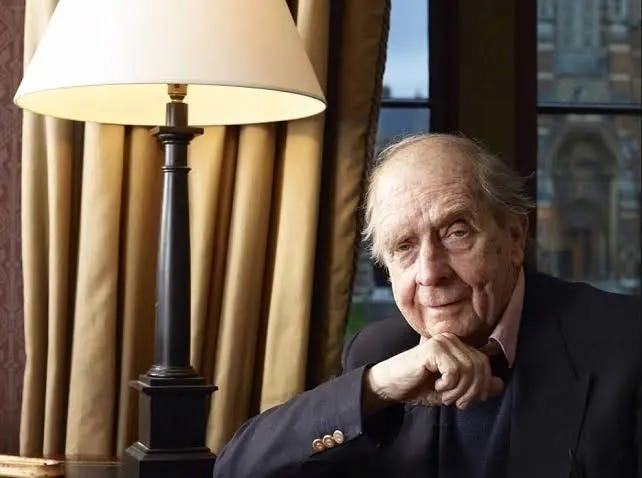
To this seemingly impossibility of harmonizing both Christianity and Secularism, Siedentop calls a “civil war”. Religious belief seems to be incompatible with “godless secularism”, even if the former led to the latter. As the population in Europe increases through massive immigration, the set of European beliefs starts to change, which is bound to create changes in our institutions.
Contrary to Christian-derived religious beliefs, Islam promotes the Shariah Law, a moral-legal tradition that aims to replace the laws of the nation-state, leading the people towards God. Of course, this is not uniformly applied; different muslim countries have a selective incorporation of these principles. It is, however, a different cultural ruleset that seems to “sit uneasily with secularism”.
This wouldn’t be a problem if we had stronger institutions, willing to take in people because they were grounded in moral equality and individual freedom. But they’re not. The sense of balance is no longer present for people because institutions no longer create civic identity, citizens no longer feel represented, and the whole European Union feels bureaucratic. National identities, rooted in self-government, a principle of freedom, were lost, creating the illusion that the only possible alternative is extreme nationalism. It’s not.
It’s also important to consider that taking migrants because “we need them for the economy”, albeit necessary, is morally wrong. We should take them because they are individuals, people. But if we lack a moral creed in the institutions that govern us, assuming that the integration will happen naturally, then we find ourselves in a disequilibrium. To be bold and blind enough to say that integration doesn’t need to happen is to step on the same river of nonsense as those who claim that integration is impossible. Immigration is compatible with our liberal system when newcomers can meet us on equal levels of liberty. This should be common sense. It’s not about different cultures but the foundational blocks that have built our society.
Norbert Elias mentions that Europeans often assume that the social norms that allowed our continent to thrive were “natural” to us, but they’re the result of a fragile outcome of historical and cultural contexts. To think that we can keep Liberalism without making a moral effort to support it is to wish upon its collapse. Only through the recovery of true, individual liberalism can we integrate new people, resist tribalism, and restore freedom.
If that which we take for granted demands discomfort for both sides of the political aisle, it can only mean that we’re walking towards the right path.