
The Red Pot
A letter to my grandma.

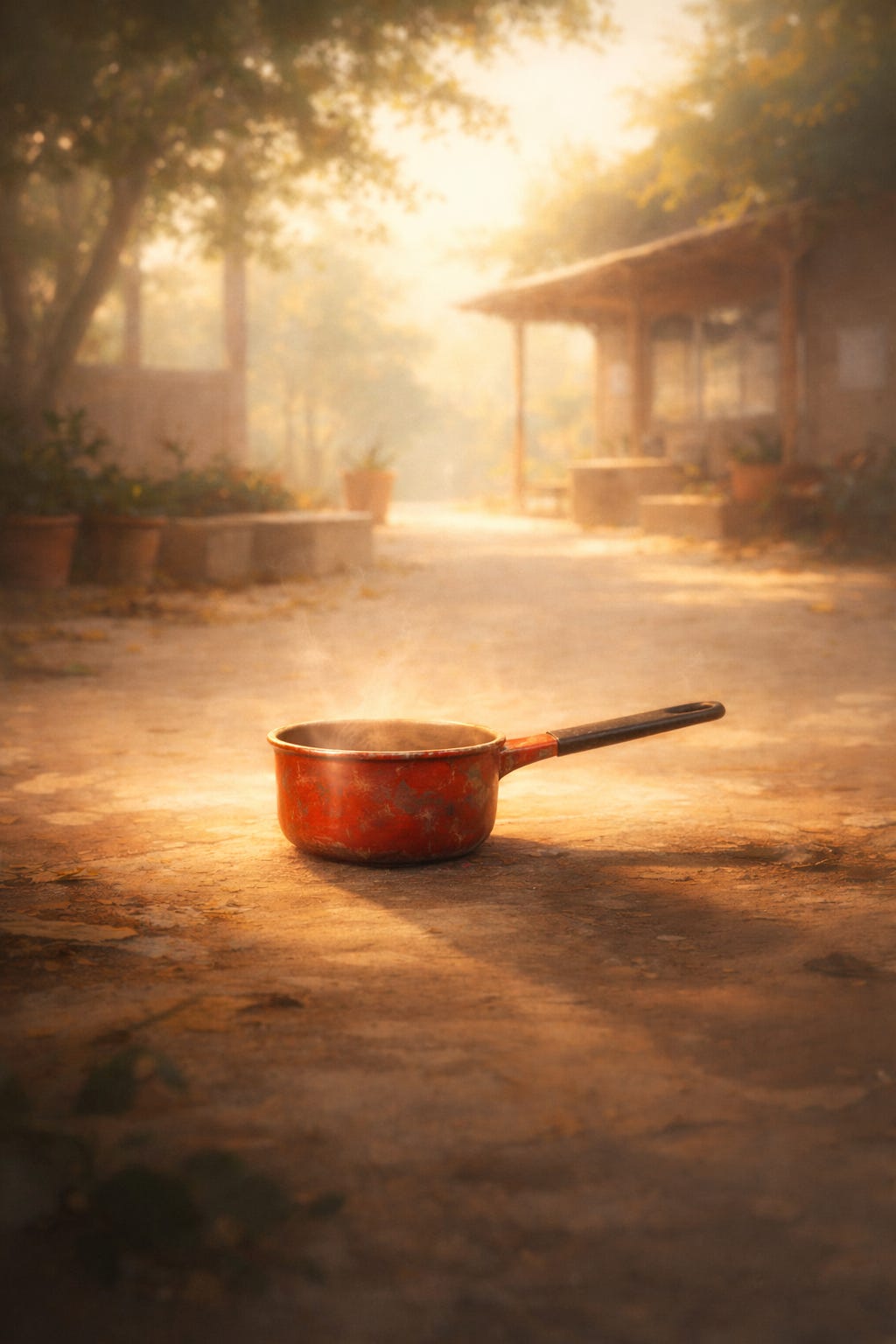
There’s a small red pot sitting in a mud kitchen within an elementary school in central Portugal. It once belonged to my grandmother and acted as a beacon of joy for a little kid who spent countless hours at her house: me.
I wasn’t even 1 year old when I travelled with my grandparents to the Algarve, a tradition I’ve repeated almost every single year since I’ve been alive, and they were still healthy enough to do the four-hour car ride. Every summer, first by myself and then with my sister, until I was old enough to babysit both of us, was spent at my grandparents’ house. My dad would leave us in the morning and pick us up at night, after work. It was a safe haven for me until late in my childhood. In a way, it still is…
In all those years, my grandma would feed us the best homemade food you can think of. You know the meme that describes grandmothers? Loads of tasty food, thinking you’re skinny all the time, and always trying to slip a bill in your hand without your parents noticing it? That’s the perfect description of my grandmother. The red pot was her “weapon” against the perpetual hunger that inhabits a young boy. Most of the time, hunger wouldn’t stand a chance.
Food plays a bigger role in my life than I was first aware of. Only in recent years, through learning how to cook, enjoying great restaurants with my girlfriend, and sharing meals with family and friends, did I fully understand the huge role it plays in my well-being and satisfaction. In trying to find the origin of that relationship with food, I always end up with a picture of that red pot.
My grandma used to cook rice in it. Her rice is, still to this day, the best rice I’ve ever eaten. I’ve tasted Michelin-star rice, and it has nothing on my grandmother’s. Not only was the rice heavenly, but if the red pot was out, it meant that the whole meal was going to be great, since all of her best dishes had rice as a side dish. Or maybe she knew I would love it and cooked it as something extra, just so she could sit at the table watching me devour it. That’s the kind of thing she would do.
Rice was a reason for celebration for that young kid. In hindsight, I can see it for what it truly was: proof of my grandmother’s care and love.
Her kitchen is now missing both the red pot and my grandma. The former, even if broken, still serves a purpose in a children’s mud kitchen. The latter, even if absent, still carries a presence within the hearts of those who love her.
Until a couple of weeks ago, I was fortunate to still have three living grandparents. I had made as much peace as one can with the likely passing of two of them. The grandmother I’ve been referring to in these pages was the third. Without warning, she was gone. Yet another reminder that our plans survive only until life arrives.
Luckily, I’ve had great people by my side to help me process this as best as I can. The most obvious one: my girlfriend. During the last year or so, we’ve had multiple conversations about death, grief, and the role of grandparents. They became foundational in shaping how I understood and learned to carry myself through this unpleasant surprise.
Each person grieves differently, and what I’m about to write applies to me alone. It’s more of a personal reminder being published and shared in my small, little corner of the internet than an attempt at “teaching” something.
If you were a fly following me around in these last few days, you could’ve developed a wrong version of who I am and how I feel about this. You could think I don’t care and that I’m even joyful that such a thing could happen. During these last few weeks, I tried to be as happy as I could. I’ve helped out those around me, I hosted a student showcase before leaving for vacations, I’ve cooked, gotten presents, read books, and worked out. Glimpses of a regular life. And yet, I am sad, and I do care about her passing and about the pain those I love are going through. But I’m also happy and joyful, which I’ll try to justify.
My grandmother’s passing did not make me want to cry. The only tears I shed came in the early hours of Christmas morning, as I stood in my kitchen, alone, drying a plate. I felt the warmth of the sun and a quiet sense of connection to her. They were joyful tears, not sad ones. What is it about this whole situation that makes me able to bear it this way?
The first thing that comes to mind is regret and how absent it was from my relationship with her.
Throughout my life, I’ve been fortunate to witness what it means to genuinely celebrate and appreciate others. Both of my parents were artists in that realm. Saying good things to people directly has a disproportionate return. It costs almost nothing, yet it can have a profound impact on someone’s life. The idea that you acknowledge good people when they do good things was part of my education. It stood in quiet resistance to the belief that you shouldn’t recognize someone for simply doing their job or, worse, that praising people openly is a sign of weakness or vulnerability. In a world where fewer people seem to care about doing things well, elevating those who do through sincere compliments is not only the moral choice, but also the logical one. I got used to saying good, heartfelt things to people early on.
Because this was such a foundational part of my own education, I always told my grandmother how much I appreciated her. I genuinely believed she knew how deeply I loved and cared for her, how grateful I was for everything she did, and how much my memories of her meant to me. Physical touch mattered to her, so I always made sure to hug and kiss her, which came easily, since that is simply what you do with a cute grandmother.
Immediately after getting the call from my mother saying that there would be a chance my grandma would die, my mind raced to the safe space provided by the certainty that, no matter what, she knew how much I loved her.
If you take away regret, what remains is simply the feeling that someone we love has been taken from us. But people are people, not objects we can hold onto forever. Others are not possessions that disappear; they are paintings we are given the chance to witness in the museum of lives, until they are moved to another room. A room none of us may enter until our own time comes, until we, too, leave the walls we inhabit as nearly oblivious paintings, being observed by others. For this reason, celebrating the blessing of having known those who depart matters more to me than longing for just one more memory with them.
I know for a fact that the core pieces of my grandma’s puzzle within me are not made of recent memories. Don’t get me wrong, I loved spending time with her, and I would have loved to have more. That is the curse of those who stay. Still, I understand that those later moments likely wouldn’t have found their way into my own treasure box.
The most impactful memories I have of her come from much earlier, when I was younger, and she was healthier. As essential parts of my worldview were taking shape, she stood as a constant example of what support, kindness, and care looked like. It’s not that another shared meal with her wouldn’t have been wonderful. It would have been. But it could never replace the deeper, more formative scenes that shaped who I am.
There is something magical about having someone embody something beautiful at the exact moment you are learning that the world can be ugly; someone who reminds you what kindness feels like when the world seems determined to promote heartlessness. Those memories are set in stone, and regardless of whether I had one more day with her, I feel she has already given me more than I could ever have asked for.
Looking back now at our last family lunch, which none of us knew was a farewell, everything feels almost poetic. It went beautifully. We were together, we laughed, and we genuinely enjoyed one another’s company. I couldn’t have wished for a better final moment with her.
If given the choice between joyfully celebrating all these moments, stories, and fragments, or yielding to a sadness that would be entirely justified, I choose the first every day. Not because sadness lacks value, but because, given my relationship with her, it feels truer to carry her warm smile forward for those who may need the space to shed a quiet tear.
My grandma embodied the spirit of beauty, joy, calm, and care. She was one of the most lovable people that I can think of, and she deserves the conscious effort of refusing to be consumed by sadness and embodying that which she stood for.
We celebrated Christmas without her, and I couldn’t help but notice that, even if a certain whimsical joy was missing, there was a renewed sense of proximity amongst my family. That is her last long-giving gift for us. Living and becoming a worthy vessel for her memories will be my present for her.
Bye, Grandma, I love you. Always will.
I haven't seen my grandmother in a long, long time, she's the only living grandparent I have. Maybe I should go and visit her. Thanks for sharing and sorry for your loss João. 💜